
Maurice

Mascara was stinging her eyes. She tugged on her lashes; a nib of black came away, which she rubbed between her thumb and forefinger. She pressed the back of her hand against her flushed cheek and fanned herself with her fingers. She thought about slipping off her coat, but that would mean wrestling off her bag and bracing it between her knees while she steeled herself in the moving tram. She hadn’t quite adjusted to Dublin’s shifting moods – the uneasy trade between outdoor chill and overheated indoor air. She indulged in a brief thought of home: face scrubbed clean, evening serum applied, idly scrolling through Netflix, dusting chocolate crumbs off her sweatpants. The comfort of later – like a dessert waiting in the fridge.
Harcourt. Sráid Fhearchair.
She nibbled the skin around her thumb, then slipped the nail between her teeth. It clicked under her incisor, until a sliver was liberated; she worked it onto her tongue and flicked it away. Her mouth was sour, tasting of instant coffee and tobacco – the cigarette she had smoked earlier still doing its rounds. She should have brushed her teeth a second time.
The Luas shuddered into the next stop. She gripped her hand around the yellow pole, and the ring on her middle finger pinged loudly against the metal. She looked around; no one had noticed. They were all slouched, absorbed by their screens, thumbs scrolling. It was interesting, the immediate retreat that happened on trains and buses. Bodies hingeing themselves into corners. Eyes lifting up, dropping down, sliding away – anywhere than at each other. The inane but human act of pretending the person next to you doesn’t exist. A self-imposed buttress that is interrupted only by a bumped knee, or by the teenager who blocks the doorway and must be asked to move. The physical limits brushing up against the emotional ones.
On Tuesday, just after 9pm, she had caught the Luas back from Parnell Street to Dundrum. There were a few seats still free; she moved towards one and sat opposite a woman in her mid-fifties, hair greying at the temples, long trench coat. Their legs were almost touching; the jostling tram periodically bringing them into close contact. As the vehicle rounded a bend, she braced and snapped her heels up. The woman’s fingers clicked over her phone screen. Her nails were painted a shade of sickly, insistent pink. She wanted to reach out then, to touch them, to run her forefinger over the glossy lacquer. The urge was so pressing a temptation as to be feared telepathic – as if the notion might bleed viscerally into the air. She turned her head away, looked at her own reflection.
Dawson. Ceann Scríbe.
Two stops left to go. She would be late.
She checked Google Maps again; she would arrive at 8:47. They had agreed to meet at 8:30. She opened WhatsApp typed out: ‘Sorry, almost there.’
His reply was immediate, reassuring, generous: ‘No rush. Take your time.’ She exhaled. Perhaps it wasn’t such a bad idea, after all. ‘Thanks!’ she texted back.
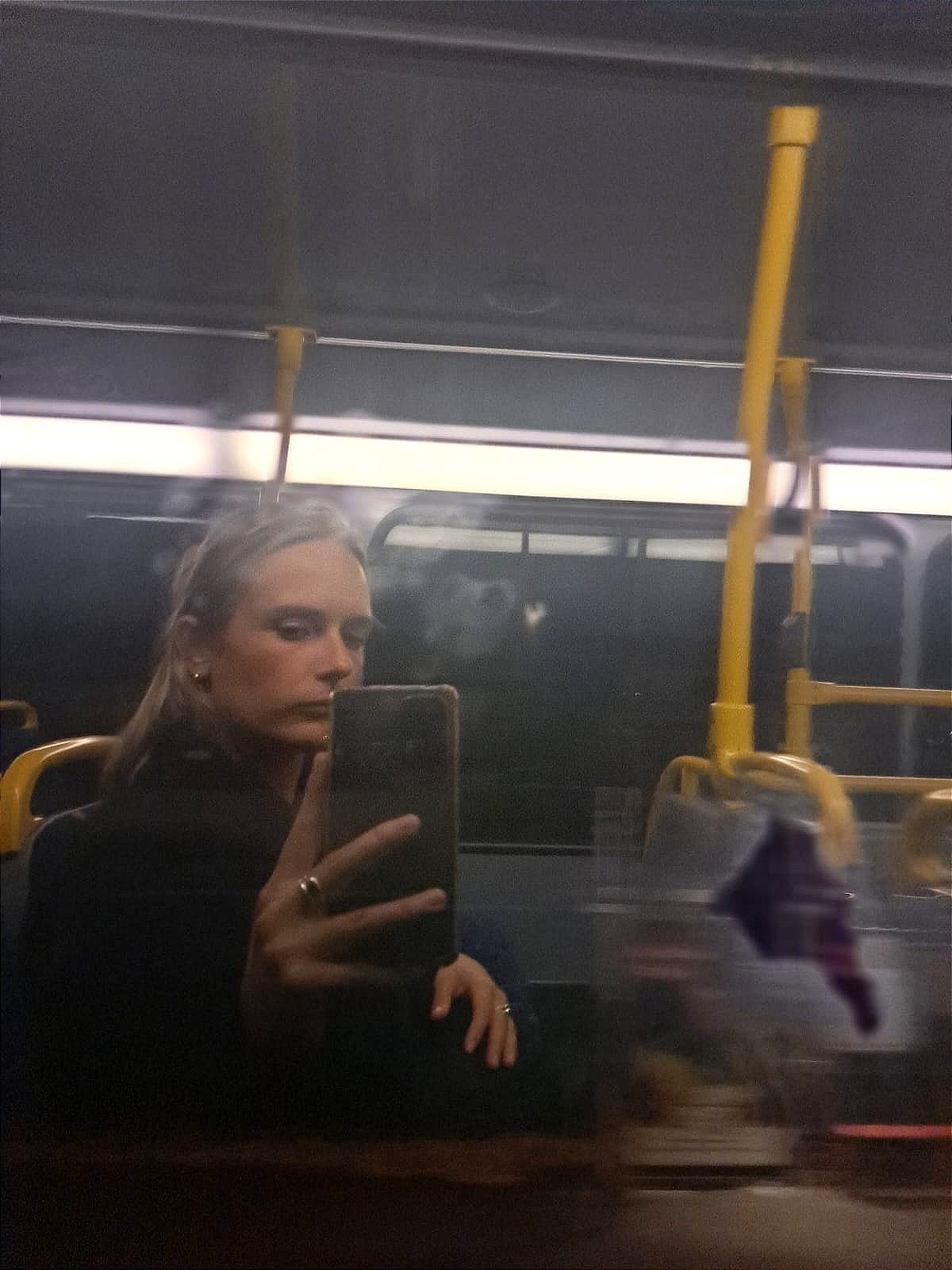
She checked her reflection: long black skirt of heavy linen, tweed buttoned coat and underneath it, a black shirt – sleeves rolled up to the elbow to reveal, once her coat was removed, a slice of the butterfly tattoo on her forearm. They were conversation starters, her tattoos. People liked to remark on them in the Tescos or beside her in the theatre or more frequently, in bars. A confident hand, pointing in the direction of her arm, insisting on the meaning of each. Why the robin on her shoulder? Why the conch near her elbow? Was she a botanist? Was the small figure on her bicep her mother or her grandmother? Sometimes she tired of the stories and made up new ones – vignettes from places she’d never been to. “I spent a summer in Peru, cataloguing Brazilian painted ladies and blue frosted banners. I developed an affinity for the creatures, which cured me of my early lepidopterophobia,” she told a man in the Palace Bar who had asked about the butterfly. “My childhood home burnt down. Everything was lost, but a field of poppies grew back in the rubble,” she told another, who had pressed a finger to the red flower that furled over her left arm. “Incredible,” he replied, eyes wide, lips slack and slippery with cider. This amused her – the creativity with which she could reinvent her character at will and at random. She might change the origin story of each depending on who was asking – knowing when to roll it out, to be liberal with the details, or when to draw a line. In any case, these were often far better stories – that yielded far better responses – than the truth: that a butterfly was, unimaginatively, a symbol of her transformation. A token of the carelessness that beset her after she turned 30. That she had come across the words ‘Everything Changes’ in the Picasso Museum in Barcelona three years prior – words stolen from Frida Kahlo, and stolen again, by her.
She alighted at Westmoreland, into the nip of late October. The air hit her cheek, billowed back into her still-damp hair. Whatever people said about the weather in Ireland, she enjoyed it. The chill revived you, awakened you. The cold was caffeinating.
She knew she could make the eight-minute walk in six. She always walked with pace; dawdlers were insufferable. Walking was, most often, transport, and time was a luxury – one there was less and less of. The days now often passed with greater force, sometimes in a wash of vague distortions. Days that were only morning and night, the middle lost to the office and its meaningless paces. To a yawning cavern of clicking pens, meetings that could have been emails, waffling presentations, and humming routers that needed to be restarted: life’s general anaesthetic.
At 8:45, she arrived, pushing against the heavy door into a swell of pubness: lyricless music, vague cheering and undulating conversations – a din from which no word or part was discernible. The kind of Saturday-night noise that becomes an extra presence, that raises the temperature of the room. There was football playing on the television above the bar. Groups of young men were huddled around, rocking back and forth on their heels, jangling the change in their pockets, checking their watches, shouting into each other’s ears, without listening to replies.
She saw him then, in the corner, tucked against the wall. His hair was longer than his pictures, pushed back behind his ears. He was wearing a navy sweater, with a white shirt underneath – the lapels peeking up through the collar. He saw her too and began rising, opening his arms in suggestion of a hug. She approached and stepped into them and they embraced briefly. He had no distinguishable smell about him – no cloying aftershave, no trace of beer breath or toothpaste. He was clean and trim, sort of scholarly. She tried to recall if his bio said he’d gone to Trinity. She’d check later, once she was home. Or perhaps she’d sneak off to the bathrooms midway and have a look.
“I ordered you a lager,” he said, nodding towards the two pints on the table.
“Thank you,” she replied.
Something deflated in her as her eyes landed on his own glass – a Guinness 0.0. A feeling as if the night was over before it had even begun. As if she was vaguely tricked – although of what, she wasn’t exactly sure. The promise, the potential perhaps, on which nights like these hinged. And yet, immediately after that came a second, more sobering and mature sensibility. Disappointment slowly gave way to something new – a fresh idea was manifesting from the smoke of her consciousness. Was it curiosity? Was she impressed by this? Could she sense in him a kind of self-assurance – a steadiness that didn’t need the encouragement of drink. Ah, there was the little nugget – her ability to surmise, to nibble away at someone’s psychology, making the scene romantic anew. A quiet smile bloomed from somewhere within, lifting the corners of her mouth. She straightened a little, rolled back her shoulders.
“How was your day? he asked.
“Good, yeah. Yours?”
“Busy, but good.”
She turned her chin at an angle; he understood the gesture and divulged: “I recently started my own company. So there’s a lot of work involved. We launched about a year and a half ago. Some days I’m there 7am to 7pm. It’s been very intense, but in time I’m hoping things will slow down.”
“Impressive.”
“I can’t complain. About the busyness. It comes with it – it’s not a bad problem to have. But it’s that time, you know? Every minute counts.”
“I see.” She held back a smile at this last comment, at the secret meanings behind it. Already she could see how those three words had the possibility of becoming an inside joke. A little shared thing between them that she could use to wheedle; a hidden ace that could be played at the right moment. Perhaps later, when the inevitable ‘home safe’ texts were shared – a comment about the 47 minutes it took to reach him, or an apology for the 15 minutes that she had kept him waiting.
She lifted her glass, hovering it above the table to reveal a watery ring on the dark wood. He followed her gaze, but the thought that seemed to be breaking across his features was interrupted by loud cheering from the bar; a goal had been scored. She set her glass back down.
“I didn’t realise there was a game on,” he said. “Do you watch sports? Are you into the GAA?”
“Not really, I admit. Besides, being South African, I’m more into rugby than football.”
“Oh? There’s that little guy on your team? The one with the blond curly hair. Vicious, just vicious.”
She didn’t know who he was referring to but nodded along anyway.
“Cheers,” she said, persisting, raising her eyebrows, taking a sip. The lager was pleasingly cold, but a little flat – the head sunken to a thin skim.
“Sláinte.”
At 9:05, he shuffled off his chair. “I just need to go to the bathroom. Be right back.”
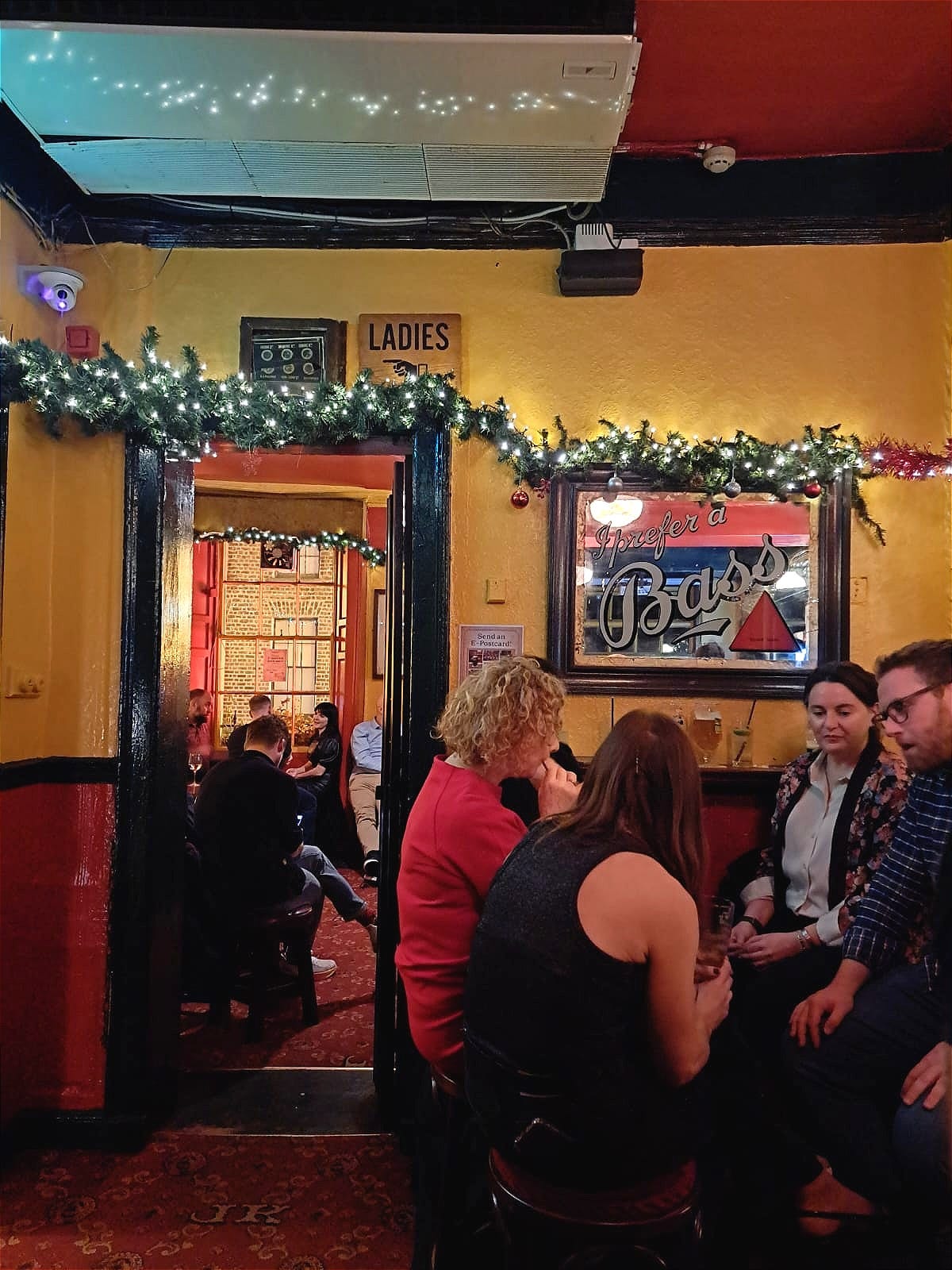
She was grateful for the intermission. She rose from her seat, untucking her skirt where it had caught in the feet of the stool. She ran a finger over her lips – they were dry, but it would be too telling to apply lipstick now. She wasn’t sure she’d want him to form that opinion of her; to perceive her potential interest. Not yet, anyway.
Time passed and she realised that she was outpacing him with the drink. The volume inside was increasing, thickening the air. It was making her flushed, quickening her inebriation. She pressed the dewed glass to the apple of her cheek and set it down. Needing more, she ran her fingers around the rim, catching droplets, which she pressed behind her ears and at her nape. Then the door to the pub opened, billowing a delicious pocket of coolness into the room.
The navy sweater and white lapels swum back into vision – he was striding towards her from the bathroom. He sat down, ran his hand quickly through his hair, and scratched his jaw.
“Would you like another?” he asked, pointing at her glass.
“Would you like to go somewhere else?”
“Oh?”
“I don’t mean… There’s nothing wrong with here. I’m just feeling a bit hot. Some fresh air might be nice.”
“We can stand outside if you prefer?”
“Maybe somewhere else.”
He took a gulp from his drink and pushed it away, then shouldered on his coat. “Shall we go?”
She took one more sip of her own, leaving behind a finger for delicacy, then slung her bag over her shoulder.
Outside, the street was awash with bodies; a press of talking heads and limbs and hats – the roar from inside the bar had followed them out. But at least the air, at least what she could tiptoe up to sip, was frosted and sweet. With so little room left on the pavement, she lost him for a moment. She was ahead, and when she turned back, there was no sight of his navy sweater or white lapels or tucked hair. She turned forward again, absorbed into the slipstream. And then she felt a hand on her arm, three fingers pawing at the crook of her elbow, and she turned, catching his smile. For a moment there was levity, breathlessness. Then his hand fell away as at last the surge gave way.
“Lost you there for a second.”
She nodded. “Where shall we go next?”
“I think I know a place. Let’s go this way.”
His gait took a more confident pace, and she fell in step beside him. He tucked his hands into his coat pockets, pausing on the edge of the pavement, looking left, then right.
“We’ll cross here.”
It occurred to her then, the force that a busy street had to heighten the feeling between two people; between strangers that were, that could be, slowly evolving into something more. She wondered if he might slip his hand out to take hers – a kind of protective gesture. It would be an easy way to grow something; a closeness that could give room to possibility. Intimacy would be too intense of a word at this point. But there would be something distinctly charged in the way of it. And so she was somewhat disappointed that they reached the other end of O’Connell with no such offer. But again, at least, she had her own interrogation – the whittling of her thoughts, turned over and examined for amusement. Her disappointment was of interest to her – was it the lager? Or was she enjoying him?
They stopped another pub. It was quieter, with potted flowers hanging from the facade. A friend, also new to the city, had once remarked on the green lanterns outside a bar in Capel Street, calling them both ‘chintzy’ and ‘familiar’. Was it the sense of something that had been staged for tourists? Or was this, the green paint, the hanging flowers, the real-deal – the source from which all later replicas are packaged and sold as ‘Irish’. But in him, a local, taking her here, she felt it was the latter. And she felt in that moment, another kind of drawing in; that she was being brought into the fold, in some capacity. Another door was opening within her, for her – her world widening, once more.
“This look alright, then?”
In the entrance room another screen was on – this time playing Darts. Low tables now, of a midnight black, and low, plush chairs of leather. Again, the general hum of conversations, but quieter, less cloying. They angled towards a free table.
“I’ll get us one,” she said.
“Thank you.”
“The same?”
He nodded. She picked up her wallet and crossed over to the bar in the next room. It was full. She waited a moment, then took the gap when it came. Minutes passed and she wondered what he was doing in the room next door. Was he checking his phone? People watching? She felt his presence, was aware of the wall between them, and she leaned her body over, like she was trying to read his thoughts through the plaster. She wondered what he thought of her.
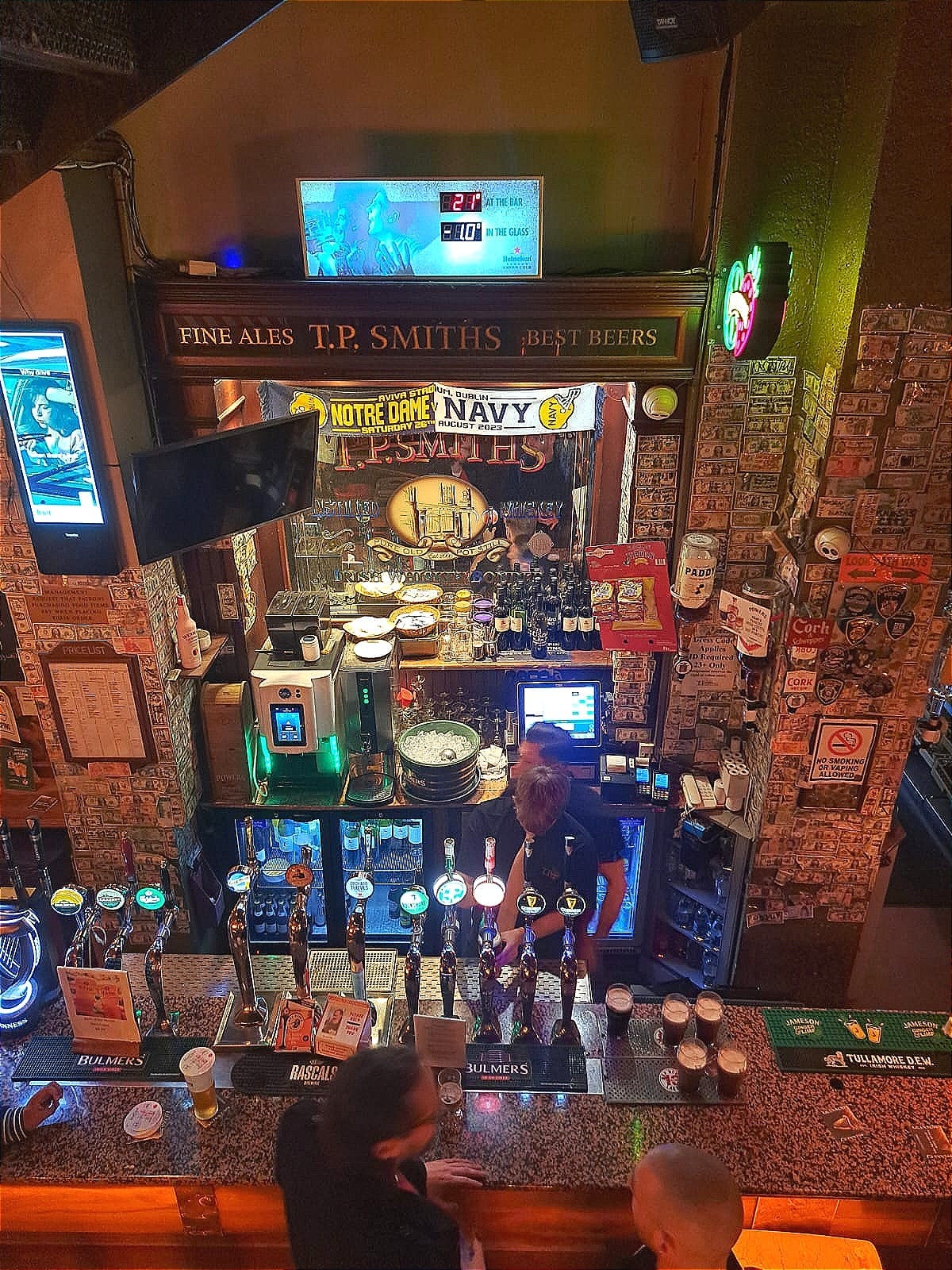
Several bartenders moved back and forth, pouring pints, handing over glasses of Prosecco, or Gin and Tonics with slices of orange. Their dress code: dishcloth over shoulder, pen behind ear, smiling inquisitions, eyes belying tiredness.
The man next to her turned: “We aren’t going to get served, are we?”
“Probably not.”
A moment later, he took his chance. “One Guinness. And a glass of Malbec.” He too must be on a date – the Malbec seemed to demand it.
She returned to the table, weaving her way between bodies, trying not to spill; the head of each glass threatening to break free.
“Sorry, it was busy.”
“No worries. So, you’re a writer then? What are you working on?”
“Everything, and nothing.”
He laughed, breaking the set of his features to produce little lines around his eyes.
“I have been working on a novel. But I’ve shelved it for now. The characters seem flat. I have an idea for a creative non-fiction project. A collection of essays. But it’s still fledging at this stage. I’m just conceptualising.”
Someone had turned the volume up on the TV, and the other eyes in the room turned to the screen.
“Do you enjoy darts?” he asked. A line of foam sat on his top lip. She thought of the lady with the pink nails. He licked it away, before the scene could evolve.
“No particular interest. Although my father’s girlfriend lost an eye because of it. Her child threw a dart at her. By mistake – well, I presume to be. And it went into her eye.”
“What?”
“Crazy, right? It sounds unreal. But it happened. So she had a glass eye.”
“Jesus.”
She nodded, rubbing the flat of her hand against her thigh, then turned her palm up, stroking her thumb against the pad of each of her fingers. She did this three times, and then balled her fist, the nail of her middle finger biting into the flesh.
“It’s a nice place,” she said.
“Yeah. They do food as well.”
They were seated close to the door, which was enjoyable for her, but seemed to be distracting for him. With each arrival, his gaze darted behind her. Perhaps he found her uninteresting. Her arms were resting on the table, but he had yet to ask about her tattoos. It was usually easy for her to tell – the wandering eye contact that lingered over parts of her body. The less subtle compliments to her scent or her hair. The slow-growing closeness, eating the shape between their bodies. The casual interest in her plans for the rest of the week. But there was none of that from him. He was either distinctly unattracted to her or decidedly assured of himself. Or perhaps merely polite and reclined. All of these options appealed to her – they were new. That his interest was something she might have to work for, that her usual charms were unwinning – these thoughts amused her. But then, what, if anything, might connect them? There was no hint of sex. Desire was not on the table. And neither was the possibility of a third drink. This was made clear at around 11pm.
“Well,” he said, leaning back. And she knew the closure of the evening was imminent. “I have a paper to finish tomorrow. And an evening flight. That’s why I’m not drinking.”
“I see,” she said, perhaps with too much interest.
“I noticed you unmatched me, by the way.”
“What’s that?”
“You unmatched me. On the app.”
She felt her stomach contract, heat rise into her cheeks.
“Oh, that. Sorry.” She looked down, and away; a painful fizzing sensation was building in her chest.
“I just thought it was a bit weird.”
“Oh, I see. It’s just.. Well, that was just me pre-empting the potential awkwardness. I thought, this may go well, or not. And if not, it can be quite awkward, having each other both still there. Not knowing at what point to unmatch each other. Seeing each other update our profiles.”
“Oh.”
“It’s just… I had a situation like this before, so...”
He shrugged, and shook his head in quick spurts, as if to signal, for her benefit, that any potential discomfort about this was now dismissed. His eyes flickered to his watch.
“Sorry, if that makes things uncomfortable?”
“No, you’re grand. Shall we go?”
She hoped that he would not be so courteous as to walk her to the tram stop. He did, after all, live in the opposite direction, so perhaps she would be saved. She could slink into the night, have a cigarette, meander past Dawson Street and perhaps slip in, alone, to another bar. Giving herself over to the evening, and what new promises they might hold.
“I’ll walk with you. There’s a stop nearby,” he said.
“Thanks.”
“What brought you to Ireland, by the way?”
“Oh, something cliché.”
“What’s that? P.S. I Love You? Normal People?”
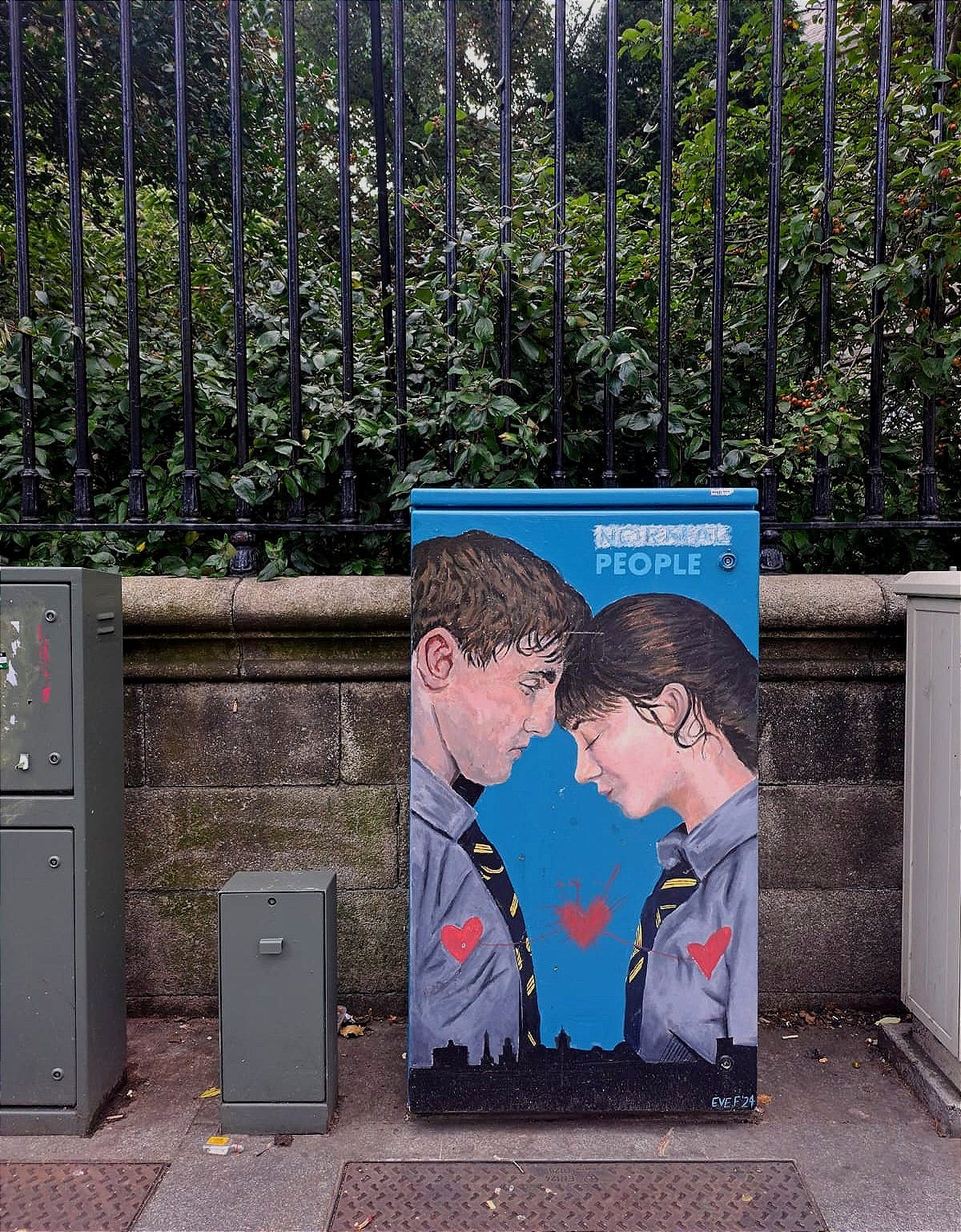
“Look!” At that moment, they were passing the traffic control box near Trinity. Marianne and Connell, captured tenderly.
“But it is, isn’t it? So… erotic,” she said. “That lingering, the tension built by two people, when it doesn’t work out.”
“I suppose.”
She looked up to the signboard. Brides Glen, arriving in two minutes.
There were last things that could be said, but they didn’t seem necessary. Already, the lights of the tram were pulling in, lighting her way home.
“That’s me, then,” she said.
He nodded. “I’ll see you. He folded his arms around his body. The tram doors opened.
“See you,” she said.
She got in, turned away. Nibbled at her thumb. She didn’t turn back to see whether he might be waving.
As always, love reading your captivating stories 💛